
Market Overview and Business Scale
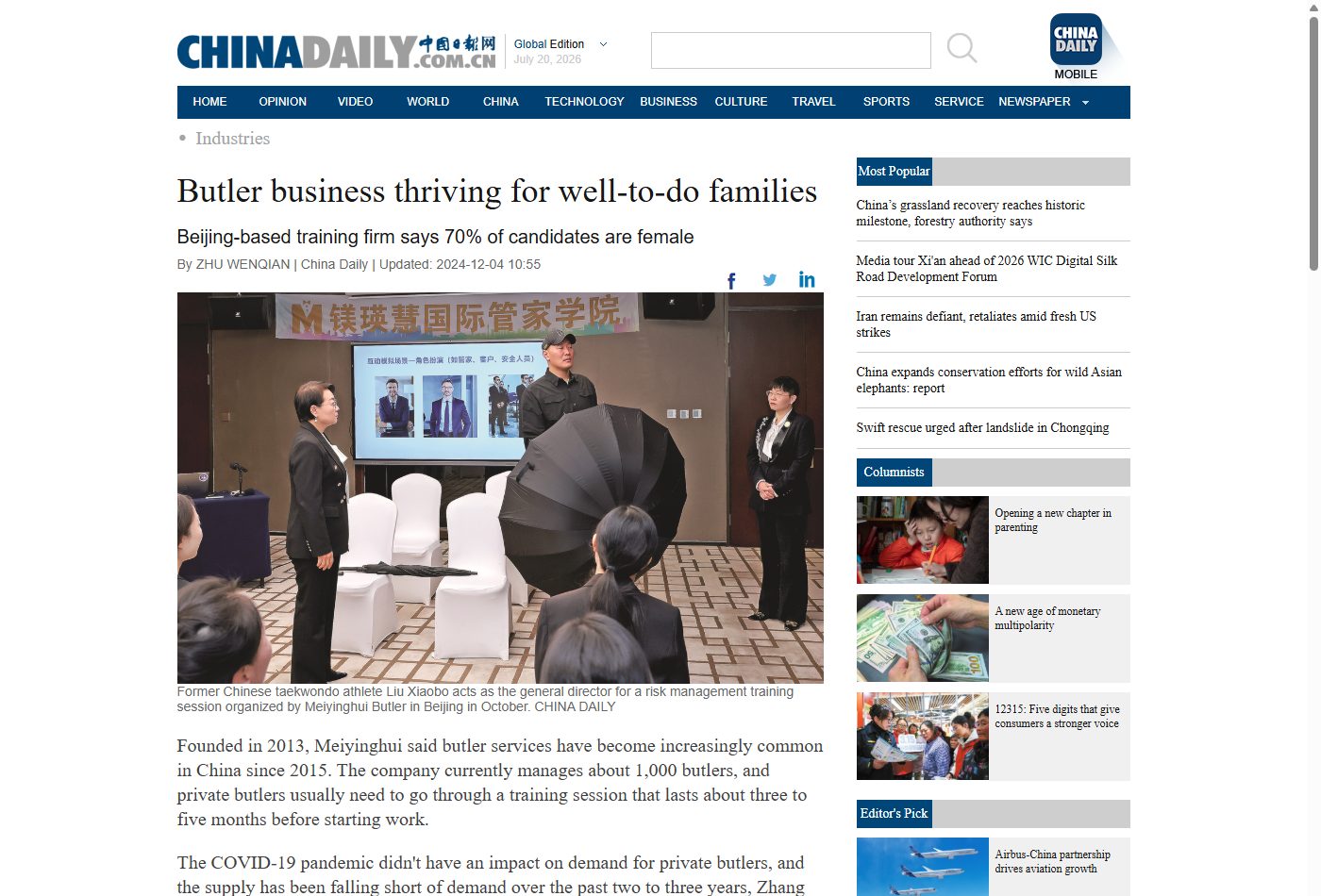
Demand for private butler services is surging among China's wealthy. According to Beijing-based training company Meiyinghui, butler services have become common in China since 2015, now managing approximately 1,000 butlers.
Private butlers typically begin work after 3-5 month training sessions, with 70% of candidates being women. Despite the COVID-19 pandemic, supply has not kept up with demand over the past 2-3 years.
This is a sunrise industry.
Employment Patterns and Long-term Relationships
Private butlers typically work long-term for their employers, commonly working for the same family for at least 2-3 years.
This long-term employment relationship enables the building of trust and continuous service improvement that is essential to butler services.
Zeng Jingjing, who has served as a private butler trainer for two years and studied in Melbourne with a business English major, comments "This is a sunrise industry," showing strong confidence in the industry's future.
Butler Pay and the Workforce
According to follow-up reporting from China Daily, private butlers earn an average of about 400,000 yuan (roughly $55,000) a year, ranging from 200,000 to 800,000 yuan depending on experience and skill.
With demand outstripping supply, terms are shifting in favor of practitioners.
About 70% of practitioners are women, and university graduates and returnees from study abroad are increasingly entering the field.
Beijing alone hosts at least five firms that manage and place butlers, and demand is spreading from major cities to second- and third-tier cities.
Growth of the Domestic Service Industry
According to the National Development and Reform Commission (NDRC), China's domestic service industry market size exceeds 1 trillion yuan with over 30 million employees.
However, the shortage of high-quality domestic service personnel is particularly pronounced, with an estimated shortage of over 20 million domestic workers.
Demand for domestic services is no longer limited to daily chores.
With the proliferation of online shopping and food delivery improving consumer convenience, demand for higher-level specialized services has become prominent, particularly in pet care, medical services, and cultural life planning services.
Higher Education Entry and Professional Status Improvement
Universities such as Jilin Agricultural University and Hebei Normal University have established domestic science majors, establishing an academic foundation for the butler profession.
Highly educated domestic science majors need not necessarily become domestic service workers, with paths open to management positions such as domestic managers, community service managers, and project managers.
According to the Henan Domestic Service Association, demand for these management positions accounts for about half of market demand, with domestic science instructors and vocational college specialized teachers accounting for 25% of market demand.
This is an important indicator of the diversification and specialization of butler-related professions.
The Wealthy Class and Luxury Housing Driving Demand
Behind the demand lies the depth of China's wealthy class. Dollar millionaires number second only to the United States—an estimated 6.3 million—and a younger, more globally experienced cohort is driving acceptance of butler services.
The luxury housing market also underpins demand. Homes priced above 10 million yuan saw an estimated 52,000 units sold across the top-10 cities in 2023, tying such wealth accumulation directly to demand for specialized in-home services.
New Profession Recognition and Market Diversification
The Ministry of Human Resources and Social Security added approximately 20 new professions to the national occupational classification list in late July 2024, including live streaming anchors, cloud network intelligent operation and maintenance personnel, user growth operation specialists, and cultural and creative product planning operation specialists.
Particularly noteworthy is the recognition of "Leisure Camp Site Butler" as a new profession, showing that the butler concept has expanded beyond traditional household services to the leisure and tourism industries.
Over half of newly added professions are closely related to new quality productive forces, reflecting diversification and new demands in people's lives.