

How to Become a ButlerThe certification path the Association sets out
Since its founding in 1890, the Japan Butler Association has worked to preserve butler culture in Japan and to develop the people who carry it.
Under Representative Director Yuichi Ishii, third-generation head of the house, the Association holds as its canon three progressive levels—Associate, Professional, and Master—together with specialist qualifications, and presents a systematic path toward becoming a butler.
No restrictions are set by age, gender, or academic background.
The certification route the Association holds as canon
A butler is not made overnight. One acquires the forms of courtesy, grows judgement in the field, and eventually reaches a vantage point from which an entire household or organisation can be held in view.
The Association makes that journey visible through its certification system. At the core of the route stand three levels: Associate Butler (entry), Professional Butler (intermediate), and Master Butler (advanced).
Across them run specialist qualifications—wine, tea, afternoon tea, table presentation, household management, travel arrangements, and more—adding depth shaped by each person’s aptitude and by the demands of the workplace.
The pages that follow guide you, in order, through the aptitudes required, the gateways into learning, what each level asks of a candidate, the place of specialist credentials, and the practice and continued study that follow certification.
Begin by grasping the whole picture, then choose the next step from where you stand today.
- Step 01Know the aptitudesDisposition and mindset
- Step 02Begin to learnDistance learning and in-person work
- Step 03Advance by levelFrom entry to advanced
The aptitudes and disposition required
Technique can be learned later. Sensitivity to the presence of others, the habit of not placing oneself too far forward, and the quiet keeping of promises—these need already to be budding as daily posture.
What the Association values is not brilliant self-assertion, but the quiet will to protect the time of the principal and family, and to keep a room running smoothly.
Flexibility—the willingness to relearn—is also part of aptitude. Lifestyles and tools change with the times, yet the core of anticipatory service does not.
Those who honour established form while updating procedure to fit life as it is lived today are the ones who grow into butlers trusted over the long term.
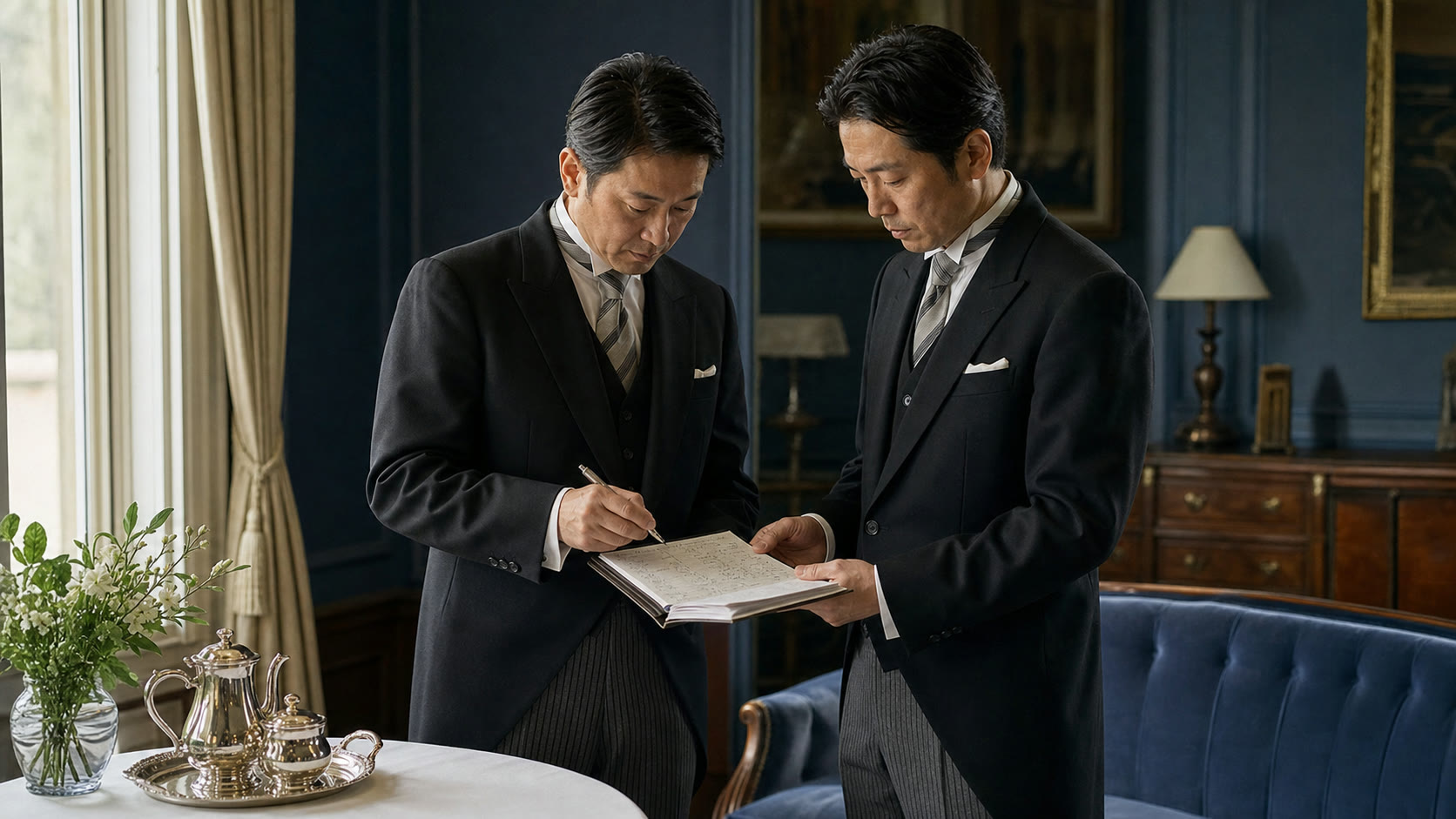
Anticipation & Awareness
Reading the room before a need is spoken, and quietly arranging the flow of the household. Butler service is not defined by reacting to requests; its essence lies in preparing one step ahead of what becomes visible.
Confidentiality & Restraint
Because a butler enters the innermost circle of a household or organisation, the discipline never to carry what one sees or hears outside is non-negotiable.
Dignity in silence, and the judgement to escalate only what must be reported, are both required.
Calm & Courtesy
Keeping tone and bearing steady even when the unexpected arrives. A bearing shaped by British discipline and the fine grain of Japanese courtesy becomes the foundation of lasting trust.
Responsibility to Keep Order
Holding a wide view of the home, the diary, the table, and the movement of people so that the principal and family can focus on what only they should address. The axis is not control, but the will to protect and support.
Gateways to learning — distance study and in-person training
There is no single entrance. Some candidates secure theory first; others begin from bodily sense; many move back and forth between the two. The distance-learning programme and in-person training are not opposites.
They are designed as twin wheels, each supplying what the other cannot fully carry alone.
Distance-Learning Programme
Take the first step while keeping the rhythm of daily life
The Japan Butler Association offers a distance-learning programme as one of its gateways.
Foundational theory, the thinking behind etiquette, and the frameworks of household management and hospitality are structured so that those who live far away or keep demanding schedules can still progress step by step.
Study does not end in solitary reading: assignments train the ability to put into words why a given procedure exists.
In-Person Training
Form that the body remembers, and the reading of atmosphere
Handling formal attire, guest circulation, table service, and the manner of reporting—domains that text alone cannot fully convey—are refined in person.
Through role-play with peers, voice, timing, and eye level are calibrated until one internalises the stance of being needed without drawing attention.
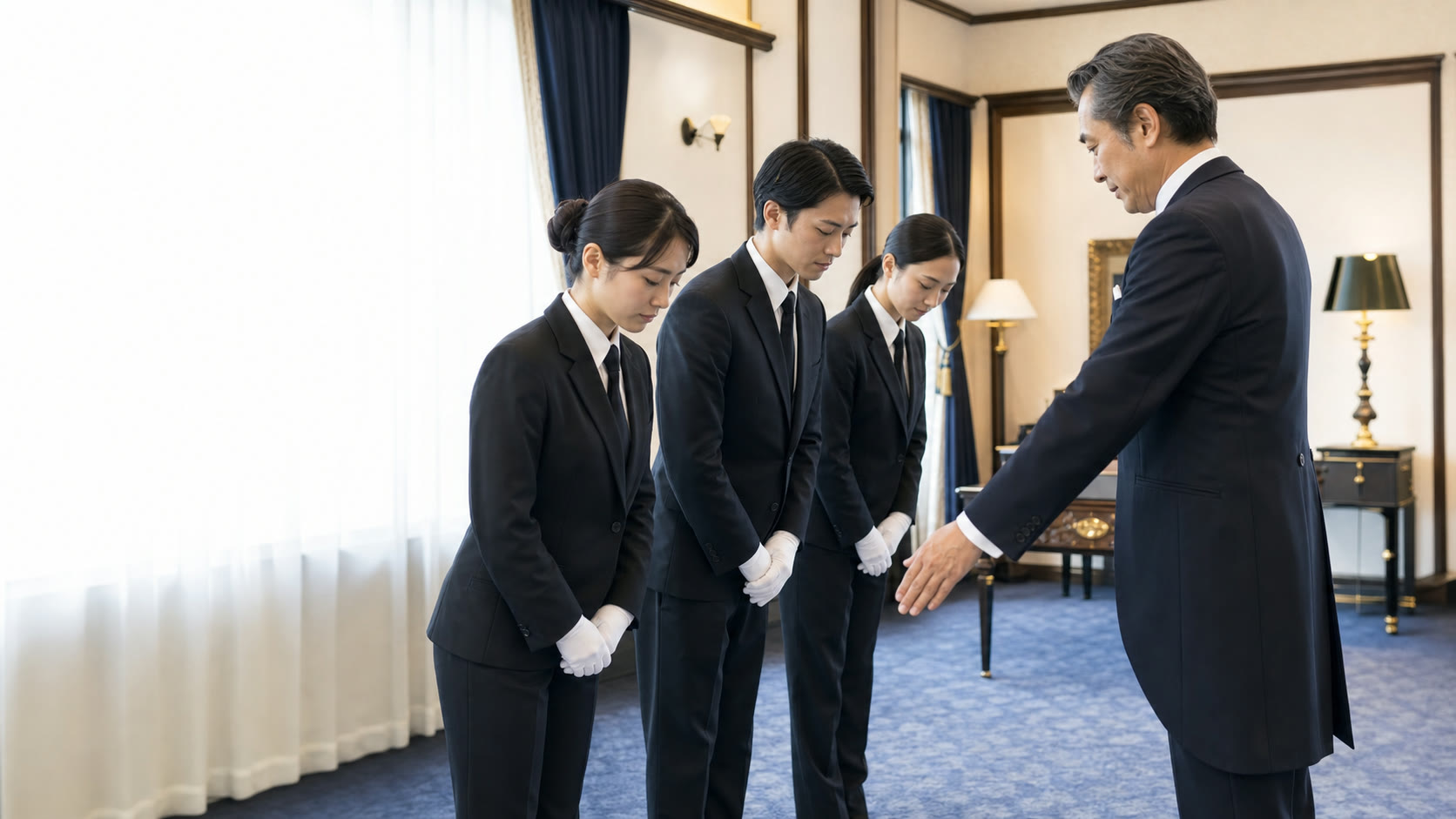
What the three certification levels ask of you
Associate Butler (entry), Professional Butler (intermediate), and Master Butler (advanced) form one continuous path—from the forms of courtesy, through judgement in the field, to the responsibility of guiding a household or organisation as a whole.
What each level examines is set out below in order.
What Associate Butler (entry level) examines
The entry level is the stage at which one acquires the shared language needed to stand on the floor as a butler.
More than brilliant presentation, it settles—without gaps—the foundations of greeting, message-taking, personal presentation, the receiving of instruction, and an awareness of confidentiality.
Here, accuracy is valued above speed, and understanding of form above personal improvisation.
- ▸Foundations of courtesy, personal presentation, and measured speech
- ▸Introductory guest reception, message-taking, and seating order
- ▸An overview of household management and the discipline of executing instructions accurately
- ▸An introduction to confidentiality and professional ethics
- ▸Patterns of reporting and liaison, and the habit of keeping records
Foundation first
The forms cultivated at entry level become the skeleton that supports judgement at intermediate level and beyond.
Over a long professional life, building a state in which basic movements can be reproduced with beauty is, in the end, a shorter path than rushing toward advanced territory.

What Professional Butler (intermediate) examines

At the intermediate level, the question is whether one can step beyond waiting for instruction and set priorities by reading the situation.
The flow of the table, guest reception, preparation for travel or events, coordination with outside partners—holding several threads at once while remaining quiet before the principal. That balance is the core of the Professional grade.
The ability to keep quality steady while running several strands of work in parallel
Practical response that includes on-the-spot judgement at the table, in hospitality, and on itineraries
Quiet leadership that extends to coordinating juniors and external partners
Proposal-led service shaped by the principal’s preferences and the house style
The capacity to fold specialist knowledge into everyday operations
What Master Butler (advanced) examines
The advanced level is at once the summit of individual skill and the stage of responsibility for guiding those who follow and the household as a whole.
More than performing perfectly on the front line oneself, one is asked to set the standard, develop people, and never lose direction in a crisis.
The Master Butler is positioned as the figure who embodies, in practice, the butler ideal the Association upholds.
- —Oversight of an entire household or organisation, and the development of people
- —The ability to keep dignity under pressure and stabilise a room by setting direction
- —Involvement in designing systems that bridge tradition and contemporary living
- —A professional outlook that sets an example for those who follow, and a posture of continuous study
- —Embodying, on the front line of practice, the butler ideal the Association upholds
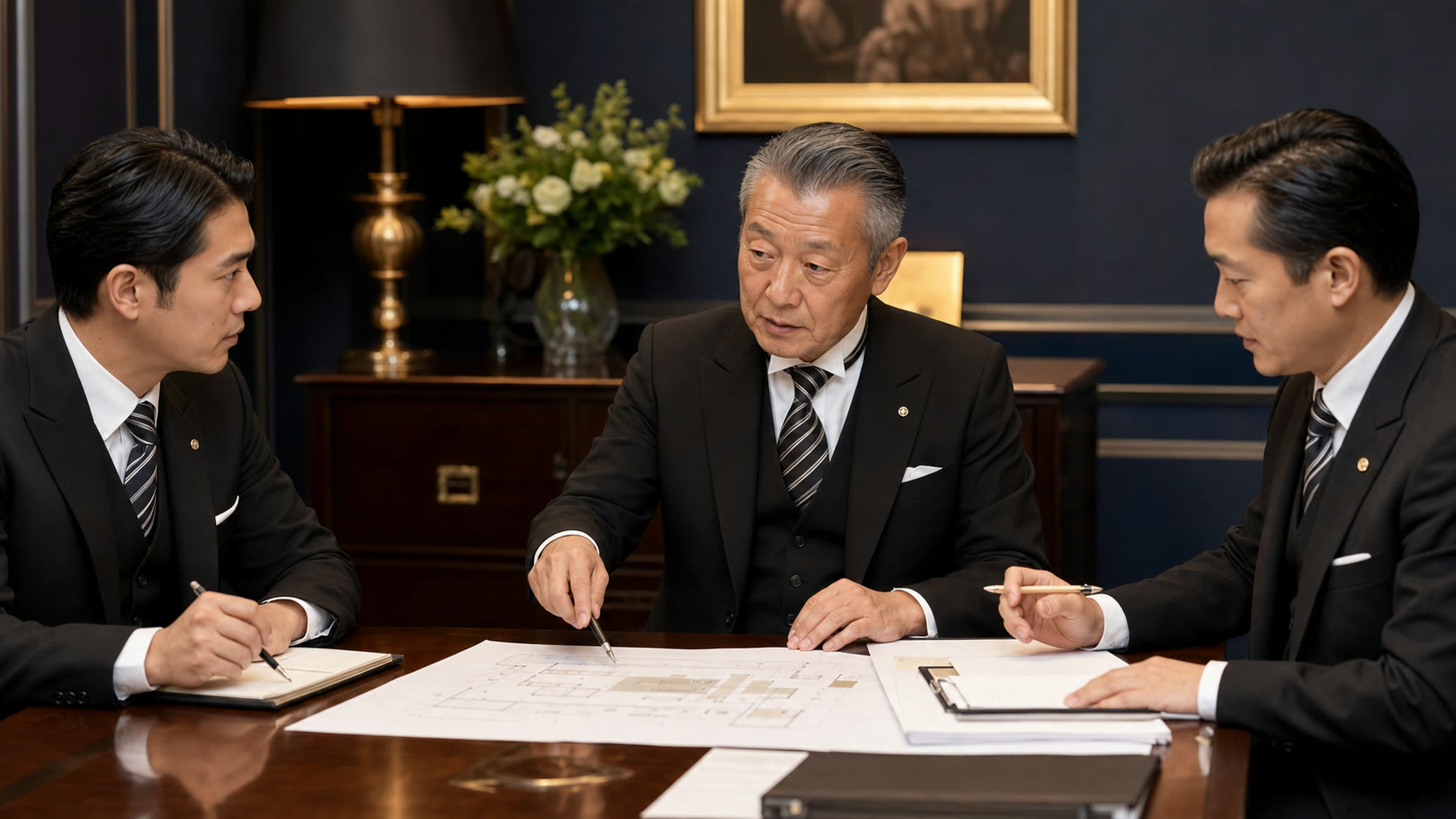
The place of specialist qualifications
Where the three core levels speak to overall capability as a butler, specialist qualifications attest to depth in a defined domain.
Wine and tea, afternoon tea, table presentation, household management, travel arrangements, business manner, uniform, and event planning—each theme connects directly to the principal’s way of life.
Specialist credentials are not a substitute for the core path. After form is secured at Associate level, they function as lateral expansion, taken across domains according to workplace demand and personal interest.
From Professional level onward, the field asks for the integrative power to dissolve that specialist knowledge naturally into daily operations.
Learning goals and content for each specialist qualification can be reviewed within the broader certification system. We recommend beginning with an overview from the certifications index.
Practice after certification and continued study
The moment a credential is in hand is when true practice begins.
Whether one enters a private household or works in corporate hospitality and estate management, the work of learning the other party’s style—and adjusting one’s own form to that house—continues.
A credential conferred by the Association is both proof of capability and a public promise not to let quality slip.
The shape of continued study differs from person to person.
Additional specialist credentials, a return to theory through distance learning, case-sharing with colleagues, and the recording of feedback from the principal—each becomes a habit that raises the precision of service that is meant to remain unseen.
Joining the learning community through membership is also an effective way to support a field role that can otherwise become isolating.
It bears repeating that the Association’s certification routes set no restrictions by age, gender, or academic background. At any point in life, the path of service remains open.
What matters is choosing the learning you need today, and building level upon level with steady care.
- Fields of practice
- In private homes, corporate settings, and events—matched to credential and aptitude—anticipatory service is put into practice.
- A cycle of study
- Insights from the field return to learning; specialist credentials and renewed study keep theory current.
- An open entrance
- Regardless of age, gender, or academic background, the certification route is open to those with the will to serve.
Frequently asked questions
QAre there age or educational requirements?
The Association’s certification routes set no restrictions by age, gender, or academic background. What matters is a spirit of service, the will to keep learning, and the posture of building trust through practice.
QWhich certification should I begin with?
Most candidates progress step by step from the entry-level Associate Butler.
It is common to strengthen theory in parallel through the distance-learning programme, and—where useful—to deepen a chosen domain through specialist qualifications such as wine, tea, or household management.
QWhat kind of continued study is expected after certification?
Certification is not an endpoint; it is the starting point for sustaining the quality of practice.
Beyond reflection in the field, candidates continue to refine skill and character through additional specialist credentials and participation in the Association’s learning community.
Choose your next step
Learn the background of the butler profession, compare certification details, or step into a community of learning—enter through the door closest to your interest.
On a lineage that has continued since 1890, the Japan Butler Association keeps developing butlers suited to the present age.